

WBS: The Blueprint of Execution
Why the WBS is Your Most Critical Post-Sanction Decision
Written by: CANalitica
14 September 2026
The project has been sanctioned. The funding is secured, stakeholders are aligned, and the green light has been given. Now, execution begins.
At this exact moment, most project teams experience an immediate urge to dive straight into scheduling tasks, writing contracts, or logging risk registers. But seasoned project professionals know that rushing into tactical management without a foundational data structure guarantees chaos.
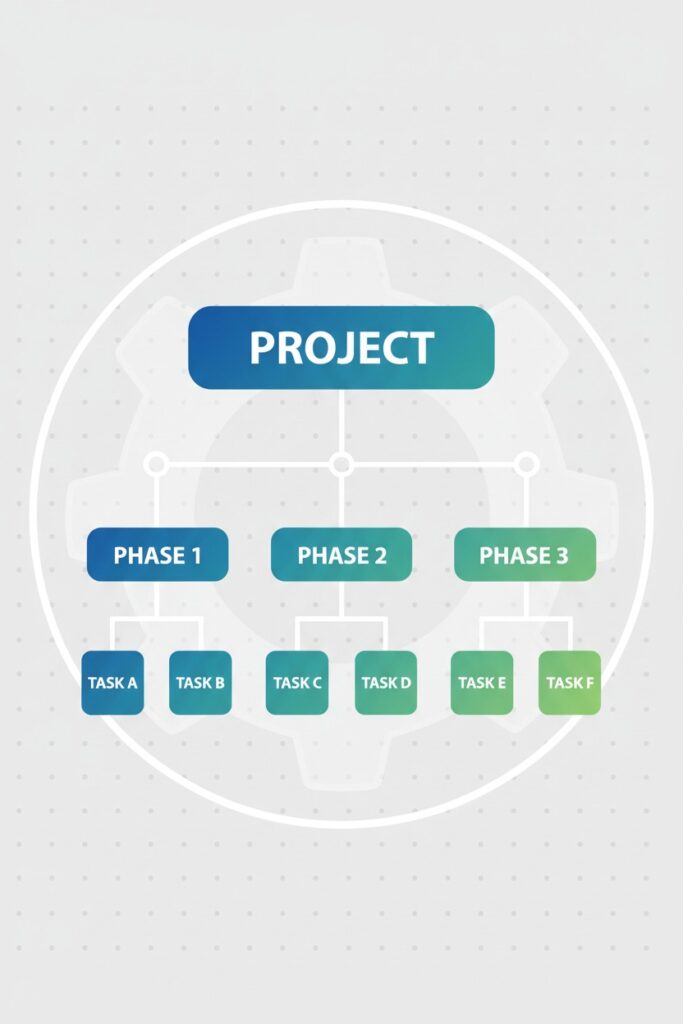
Before you build a schedule or track a single dollar, you must establish your Work Breakdown Structure (WBS).
The WBS is not a simple preliminary chore to be typed up and forgotten. It is the first and most important item when planning a project. Far beyond a basic tool for tracking costs, a well-engineered WBS is the universal framework that organizes every single facet of your project asset.
The Universal Organizing Framework
Once a project is sanctioned, it generates an overwhelming wave of disparate data streams. The WBS acts as the master directory, grouping your project into distinct, deliverable-oriented components.
By establishing a clean hierarchy early, the WBS serves as the single point of alignment for five critical dimensions of project execution:
- Scope Accountability: It maps the total authorized work of the project. If an activity doesn’t map to a specific child node in the WBS, it is out of scope—making it your primary shield against scope creep.
- Risk Categorization: Instead of managing a massive, flat spreadsheet of disjointed project threats, a mature WBS allows you to categorize and roll up risks by physical asset or functional area, showing you exactly which deliverables carry the highest risk profile.
- Stakeholder Attention & Governance: Executive sponsors and external partners don’t need to see daily field tasks. The WBS creates a natural communication ladder, allowing you to summarize complex progress metrics into clean, high-level reporting tiers designed for leadership oversight.
- Project Outcomes & Deliverables: Because a true WBS is built using nouns and adjectives rather than action verbs, it forces the project team to stay relentlessly focused on what is being physically delivered, rather than getting lost in the chaotic noise of how the work is being done.
- Cost & Schedule Integration: By providing a unified hierarchy, it allows your budget, timeline, and actual expenditures to talk to one another using the exact same physical baseline.
Rethinking the WBS: Value Beyond Cost Tracking
While traditional project controls emphasize using the WBS to monitor expenditures, restrictive “cost-code only” thinking limits your project’s data maturity. When engineered strategically, a WBS can be leveraged to drive performance in entirely non-traditional ways:
- Engineering and Design Progress Maturity: For complex design packages, a WBS can track progress using weighted milestone gates (e.g., test environments ready, or specific diagram sign-offs). This quantifies intellectual progress in concrete numbers long before construction expenditures begin.
- Independent Quality Verification: You can tie specific WBS work packages directly to quality gate reviews or third-party site inspections. Progress is only “earned” once independent verification confirms the standard of the physical output.
- Contractor & Vendor Management: Splitting your WBS branches cleanly by major contract packages or physical installation areas allows you to isolate contractor efficiency side-by-side, giving you a data-driven baseline for future procurement negotiations.
How PMBI Transforms Your WBS into Live Intelligence
In CANalitica PMBI, your project’s WBS is the definitive data backbone. Our platform natively processes up to a 5-level WBS hierarchy, giving you the precise architectural space needed to structure complex capital assets.
Here is how PMBI capitalizes on a strong WBS to empower your project delivery:
- The Single Point of Alignment: When you link your project through our Data Connections page, PMBI uses your WBS table to automatically coordinate all subsequent data streams—including your Budgets, Tasks, Planned Value, and Actuals.
- Interactive Drill-Down Capabilities: Executives don’t get lost in row-by-row detail. PMBI’s Main Dashboard features a synchronized WBS Filter that allows stakeholders to look at portfolio-level indicators (like SPI and CPI) and seamlessly click to drill down into specific work packages.
- AI Summary Anchoring: Our optional AI Project Summary feature requires a coherent WBS to function accurately. When writing your plain-language monthly project health narrative, the AI model reviews metrics specifically tied to your WBS hierarchy, accurately isolating and documenting your exact Key Risk Drivers without confusing flat data noise.
Full data details can be found in the PMBI User’s Guide, but essentially PMBI requires the following WBS oriented data:
The WBS table requires the dot-delimited WBS code (WBS_ID) and its title/name (WBS_level_name).
All other tables within PMBI will later be linked to this table to enable filtering and reporting.
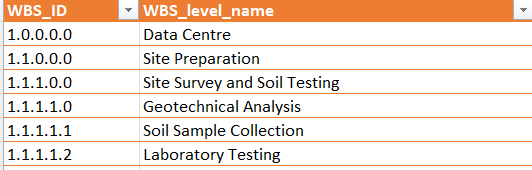
Establishing your WBS is the key to maximizing the benefits of using PMBI. Additional resources can be found in the PMBI User Guide on our Resources page.
Standardize Your Project Reporting Without the Infrastructure Headache.
Discover how clean data modeling unlocks real-time SPI, CPI, and AI-driven project health narratives without changing your team’s day-to-day software tools.